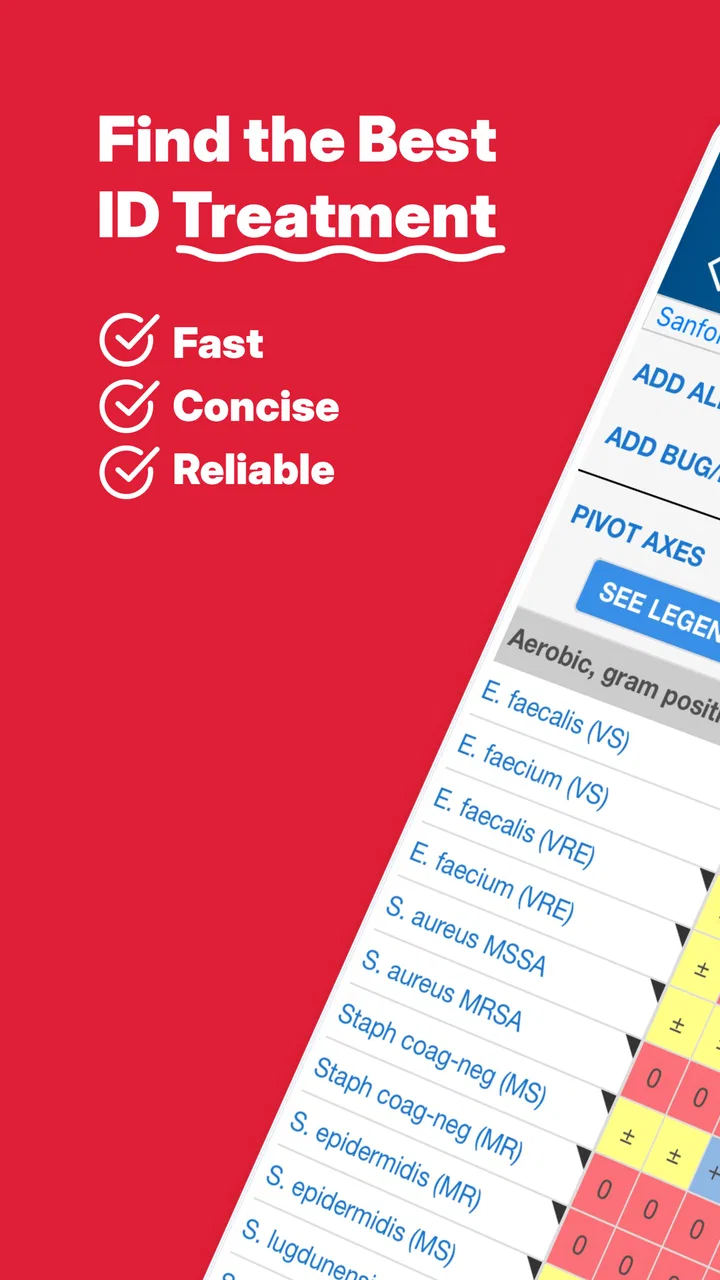
Sanford Guide Antimicrobial
- 4.8
- Rating
- 500.00K
- Installs
- Free
- Price

 Analysis by App-foxy
When I need a dependable clinical reference for infectious diseases, I want something that helps me move from a patient question to a sensible treatment discussion without making me dig through a pile of unrelated material. That is where Sanford Guide Antimicrobial makes its case. It is a medical app from Antimicrobial Therapy, Inc., built around infectious diseases treatment information rather than general wellness advice or symptom tracking. In my experience, its main value is focus: it is designed for people who already understand clinical language and need a compact reference at the point of care.
I would not describe it as a beginner-friendly health app, and I would not use it as a substitute for diagnosis, local protocols, laboratory results, or professional judgment. I see it instead as a specialized companion for clinicians, students in health professions, pharmacists, and other medically trained users. The app is free to install and is marked for Everyone, although some of its more useful material is connected to in-app purchases ranging from $4.99 to $79.99 per item. That difference between easy access and potentially significant paid content is important to understand before relying on it as a long-term reference.
How the reference works in real clinical study and practice
I use this section to focus on a practical question: how to turn a specialist reference into a safer, more deliberate workflow rather than a shortcut to a treatment decision. A useful habit is to note the patient-specific details that could change an option before looking anything up, then check those details against the relevant guidance. That makes the reference a prompt for careful comparison, which leads naturally to how the app’s focused format can help in study and practice.
You May Also Like

 Blood Strike: 2.5 Anniversary
Blood Strike’s Loadouts Turn Every Drop Into a Tactical Gamble
A close look at Blood Strike’s custom loadouts: how fast access to signature weapons reshapes its battle royale rhythm, rewards preparation, and narrows the gap between fights.

 Pandora - Music & Podcasts
Pandora’s Music Is Easy to Start, but Harder to Recover
Pandora’s strength is its low-effort path from a seed to a station. Its weak spot is how much confidence it asks you to place in connection, setup, and quiet recovery.

 8 Ball Pool
 Is Built on Rivalries, Rematches, and Routine
A close look at the rivalries, rematches, shared routines, and unanswered safety questions that turn a quick pool match into a persistent mobile community.

 Samsung Music
’s Quiet Strength Is Playing What You Already Own
Its reach comes less from spectacle than from dependable access to a personal library. That simplicity is both the app’s strongest retention engine and its ceiling.

 AccuWeather: Weather Radar
AccuWeather Review: A Quick, Clear Forecast for Everyday Decisions
For everyday plans, the best forecast is the one you can understand quickly. AccuWeather makes rain timing, radar, and local conditions easy to act on, with a few trade-offs.

 Hill Climb Racing
Why Hill Climb Racing Still Turns Crashes Into One More Run
A tiny car, a bumpy hill and one more upgrade: Hill Climb Racing keeps resurfacing because its simple chaos makes every near-miss feel personal.
More From Our News Desk



A focused tool rather than a general medical encyclopedia
The first thing I noticed is how narrow the app’s purpose feels compared with broad medical reference products. Its store summary is “Infectious Diseases Treatment,” and that description is a fair guide to the experience: the app is concerned with antimicrobial decision-making, not with covering every specialty equally. That focus is useful when I am reviewing an organism, a syndrome, or a treatment question and do not want to wade through cardiology, dermatology, nutrition, or general self-care content.
That specialization also changes how I read the app. I do not open it expecting a conversational explanation of what a fever might mean. I open it with a clinical question already in mind. For example, during study, I might start with a suspected infection and use the reference to compare treatment approaches, then pause to check whether the choice makes sense for the patient’s context. The app works best as the middle step between identifying the problem and making a carefully verified decision.
This is a meaningful distinction from ordinary medical search tools. A web search can produce a huge mixture of hospital pages, old articles, commercial content, and patient-oriented explanations. A general drug reference may tell me about a medicine’s uses and cautions without giving the infectious-disease context I actually need. Sanford Guide Antimicrobial is more useful when the question is specifically about antimicrobial therapy and the reader already knows how to interpret clinical information.
Why the focused format can save time
In a busy study session, the advantage is not simply having information on a phone. The advantage is having a reference whose subject boundaries are clear. I can approach it with a treatment problem instead of spending time deciding which broad medical database might contain the answer. That makes it especially practical for quick revision, ward preparation, or checking a point before discussing it with a supervisor or colleague.
A realistic example would be a trainee preparing for a case discussion involving a patient with a suspected bacterial infection and a complicated medical history. I would not use the app to make the final prescription in isolation. I would use it to organize the antimicrobial part of the discussion: what treatment questions need answering, which patient factors might change the choice, and what details deserve confirmation in the patient’s chart or local guidance. That workflow is safer and more useful than treating any reference as an automatic prescribing engine.
Another good use is deliberate comparison. Instead of memorizing one drug as the answer to one infection, I can use the reference to think through why alternatives may be considered and what clinical details could make one option more appropriate than another. That habit is more valuable than simply searching for a drug name and copying the first result.
Useful for learning, but not a replacement for teaching
Students may find the app helpful because it gives infectious-disease topics a practical structure. It can support revision after a lecture, help prepare questions for a clinical teacher, and make it easier to connect organisms, syndromes, and antimicrobial choices. I especially like the idea of using it as a “second pass” over material: first learn the principles from a course or textbook, then use the app to test whether I can apply those principles to a treatment scenario.
Still, I would not recommend learning antimicrobial therapy exclusively through this app. A concise clinical reference is good at helping me retrieve information, but retrieval is not the same as understanding microbiology, pharmacology, resistance mechanisms, adverse effects, or the reasoning behind stewardship. A student who reads only the treatment entry may know what is commonly listed without understanding when that recommendation needs adjustment.
My preferred workflow is to pair the app with formal teaching and local guidance. I use it to frame questions, then verify patient-specific details elsewhere. That approach also prevents a common mistake: assuming that a concise recommendation automatically applies to every hospital, region, age group, pregnancy status, renal function, allergy history, or resistance pattern.
The cost question deserves attention
The app itself is free, which makes it easy to try before deciding whether it belongs in a regular clinical-study routine. However, the presence of in-app purchases means the free starting point should not be confused with complete access to everything a professional user may want. The listed purchase range runs from $4.99 to $79.99 per item, so the financial commitment can vary considerably depending on which material is needed.
I would handle this in a practical way. Before building a workflow around the app, I would open it, inspect what is available without payment, and identify whether the specific topics I need are included in the access level I am considering. For a student, that may mean checking whether an institution already provides access or deciding whether occasional use justifies a purchase. For a working clinician, the question is less about the download price and more about whether the content saves enough time and supports enough decisions to earn a place among existing references.
This model is not automatically a weakness. Specialist references often require ongoing editorial work, and paid content can be reasonable when it provides substantial clinical value. The friction is that the app’s usefulness may depend on exactly which sections are unlocked. I would rather make that decision after testing the navigation and relevance of the free portion than assume the free installation represents the entire experience.
Where it fits beside familiar alternatives
Compared with a printed infectious-disease handbook, the app is easier to carry and more convenient for quick consultation. A book can still be better for uninterrupted reading, annotation, and building a broad conceptual understanding. I find print particularly comfortable when I am studying a complete topic rather than answering one focused question.
Compared with a general online search, the app offers a more disciplined starting point. Search engines are useful for finding guidelines, institutional documents, and recent discussions, but they also require more judgment about source quality and relevance. Sanford Guide Antimicrobial is less useful when I need a newly published research paper, a local hospital policy, or a detailed explanation aimed at a patient. In those cases, a guideline repository, primary literature database, or patient education source may be the better choice.
Compared with a broad drug-information app, this one is more attractive when infection treatment is the central issue. A general medication reference may be preferable when my question concerns interactions, administration instructions, or a medicine’s noninfectious uses across many specialties. The trade-off is clear: Sanford Guide Antimicrobial gains depth by staying focused, while a broader tool may cover more types of medication questions in one place.
Limitations I would take seriously
The biggest limitation is the risk of overconfidence. A polished treatment reference can make a difficult clinical decision look simpler than it is. Antimicrobial choices depend on the suspected source, severity, cultures, allergies, organ function, prior exposure, resistance patterns, immune status, and local practice. Even a strong specialist reference cannot replace the information gathered from the patient and the care team.
That means the app is not the right choice for someone looking for a diagnosis from symptoms. A parent worried about a child’s fever, a person deciding whether to take leftover antibiotics, or a user seeking a simple explanation of an infection should choose a patient-oriented medical source and speak with a healthcare professional. The technical focus here could confuse rather than reassure a general audience.
I also see a practical limitation in depending on a mobile reference during situations where access, attention, or verification is constrained. A phone-based tool is convenient, but it can encourage hurried checking. I would not let a quick screen search replace reviewing the full clinical picture or consulting a pharmacist, infectious-disease specialist, or local protocol when the case is complicated.
Another trade-off is that a reference app may feel less satisfying when I want a teaching narrative. It can help answer “what should I investigate next?” or “which treatment options should I compare?” but it may not teach the underlying subject as patiently as a textbook or lecture. Users who prefer step-by-step explanations may need another resource alongside it.
Who will get the most from it
I think the strongest audience is healthcare professionals and advanced learners who already know the basic vocabulary of infectious diseases. Medical students, residents, pharmacists, nurses working closely with antimicrobial therapy, and clinicians who regularly encounter infections are the people most likely to benefit. For them, the app can serve as a compact reference during revision and as a prompt for more careful clinical reasoning.
It is also useful for someone who wants to prepare before a case conference. I can review the relevant infection category, write down the points that need confirmation, and arrive with more focused questions. That is a better use than opening the app only after a decision has already been made and treating the first relevant entry as a final answer.
I would recommend skipping it if the goal is everyday health advice, symptom checking, or a simple medication reminder. It is also a poor fit for anyone unwilling to verify clinical information against current local guidance. The app’s value rises with medical knowledge; without that foundation, its specialized content may be difficult to interpret safely.
What I would check before depending on it
Before making it part of my routine, I would confirm three things. First, I would check whether the topics I actually encounter are available at the access level I can use. Second, I would compare its recommendations with the protocols used in my workplace or training program. Third, I would make sure I can use it as a reference without losing the habit of checking patient-specific factors and current laboratory information.
I would also keep a personal list of recurring questions rather than searching randomly. For example, I might note which infectious syndromes I find difficult, which drug classes I confuse, and which patient factors most often alter treatment. Then I can use the app for targeted review and return to the same topics after a case. This turns it from a passive lookup tool into a more effective study aid.
The app has been available since August 4, 2014, and its current version is 7.1.4. It supports operating systems from version 9 onward, which makes compatibility worth checking on an older device before planning to use it during work or study. Those details are not the reason to choose it, but they matter when a reference is expected to be available at short notice.
My final recommendation
Sanford Guide Antimicrobial succeeds because it knows what it is trying to be: a focused infectious-disease treatment reference rather than an all-purpose health companion. I appreciate that specialization. When I already understand the clinical question, it can help me structure my thinking, compare treatment considerations, and prepare for a more informed discussion. Its free installation lowers the barrier to trying it, while the paid content means I would evaluate the available material before committing to regular use.
The app’s reputation is strong, with an average rating of 4.8 from around 4.5 thousand ratings, and it has passed half a million installs. Those figures suggest that it has found a substantial audience among people who need this kind of reference, although popularity should never replace checking whether its approach fits my own training and clinical environment.
My verdict is positive but specific: I would recommend it to medically trained users who want a portable antimicrobial reference and understand its limits. I would not recommend it as a diagnostic tool, a patient self-treatment guide, or the only source used for prescribing decisions. Its real strength is helping an informed reader ask better treatment questions, not making those questions disappear. Used alongside local protocols, clinical assessment, and appropriate professional advice, it is a worthwhile specialist app. Used without that context, even a well-organized reference can create more confidence than certainty.
FAQs for Sanford Guide Antimicrobial
01What is the Sanford Guide Antimicrobial app used for?
The Sanford Guide Antimicrobial app is a comprehensive resource for healthcare professionals. It provides detailed information on the treatment of infectious diseases, including antimicrobial therapy recommendations, dosage guidelines, and pathogen information. It’s an essential tool for clinicians seeking quick, reliable guidance in managing bacterial, fungal, and viral infections.
02Is the Sanford Guide Antimicrobial app suitable for non-professionals?
While the app is designed primarily for healthcare professionals, such as doctors, pharmacists, and medical students, anyone with a strong interest in infectious disease management may find it informative. However, the content is highly technical, and those without a medical background might find it challenging to understand.
03How frequently is the information in the Sanford Guide Antimicrobial app updated?
The Sanford Guide Antimicrobial app is regularly updated to ensure users have access to the latest clinical guidelines and recommendations. Updates typically include new drug approvals, resistance patterns, and treatment protocols, reflecting the most current research and clinical practices in antimicrobial therapy.
04Does the Sanford Guide Antimicrobial app require an internet connection?
The app can function offline, allowing users to access critical information anytime, anywhere. However, an internet connection is necessary for downloading updates and accessing additional features such as news alerts and supplementary resources, ensuring you have the most accurate and up-to-date information.
05Can I customize the Sanford Guide Antimicrobial app to suit my needs?
Yes, the app offers customization options to tailor your experience. You can bookmark frequently used pages, set preferences for notifications, and search for specific pathogens or drugs. This flexibility helps streamline access to the information most pertinent to your practice or study requirements.
Pros
- Comprehensive antimicrobial database.
- User-friendly interface for quick access.
- Regular updates with latest guidelines.
- Offline access available for convenience.
- Customizable search filters for precision.
Cons
- Requires subscription for full access.
- Limited features in free version.
- Occasional app crashes reported.
- No dark mode for nighttime use.
- Large app size may affect storage.

Sanford Guide Antimicrobial
Gallery